Last updated: January 2026. Based on discussions from r/productivity, r/getdisciplined, r/ADHD, r/selfimprovement, and r/digitalminimalism.
"I've downloaded 47 productivity apps in 3 years. I know because I counted. I'm still not productive. I'm just really good at setting up Notion templates."
This confession got 2,400 upvotes. Because we've all been there. The endless cycle of hope, setup, excitement, then silence. Another app icon gathering dust on page 5 of your phone.
Let's talk about why this happens. Not the surface reasons. The real ones.
The App Graveyard: Why Your Phone is Full of Dead Planners
Here's the brutal pattern most people don't want to admit:
The 2-Week Death Spiral
- Day 1-3: Excitement. Watch YouTube tutorials. Set up perfect categories. Choose nice colors.
- Day 4-7: Actually use it. Feel productive. Tell friends about this amazing app.
- Day 8-11: Skip a day. Feel guilty. Open app, feel overwhelmed by backlog.
- Day 12-14: Open app less. Notifications become annoying. Mute them.
- Day 15+: App joins the graveyard. Start googling "best productivity apps 2026."
Sound familiar? You're not broken. The apps are designed wrong.
The Complexity Trap
Here's what productivity app companies won't tell you: they make money by adding features. More features = more perceived value = higher prices. But more features also = more complexity = more friction = abandonment.
I spent 6 hours building my "perfect" Notion setup last year. Databases linked to databases. Custom properties. Formulas. It was beautiful.
I used it for 9 days.
Know what I use now? A paper notebook and one simple app. Because I'm actually doing things instead of organizing things.
Reddit's Harsh Truth About Productivity Apps
Top comment: "The best productivity system is the one you'll actually use. That's usually the simplest one. Nobody wants to hear this because setting up complex systems feels productive."
Reply with 800 upvotes: "Organizing your tasks IS a form of procrastination. Change my mind."
Why Gamification Feels Hollow After Week 2
Forest. Habitica. LifeRPG. Apps that turn productivity into a game.
They work. For about 11 days.
Then the dopamine hit from virtual coins stops mattering. Your brain figures out the game is fake. The tree growing on your phone doesn't actually change your life.
"I had a 200-day streak in Habitica. My character was legendary. My actual life was still a mess. Turns out fighting virtual dragons doesn't clean my apartment."
The problem isn't gamification itself. It's that these apps gamify the wrong thing. They reward task completion. Check the box, get the coin.
But life isn't about completing tasks. It's about balance. You can check 47 boxes and still feel empty because all 47 were work tasks and you haven't called your mom in 3 months.
The Real Problem: Apps Optimize for More, Not Better
Every productivity app I've tried has the same implicit promise: help you do MORE.
- More tasks completed
- More habits tracked
- More projects managed
- More, more, more
But what if doing more isn't the goal?
What if the goal is doing the right things? What if it's actually doing LESS of the wrong things?
Most task apps don't help with that. They just give you a prettier list of everything you're failing to accomplish.
What Reddit Actually Recommends (After the Graveyard Phase)
There's a pattern in r/productivity. New users ask "what's the best app?" Experienced users say "it doesn't matter." Here's what the veterans recommend:
| Problem |
Wrong Solution |
What Actually Works |
| Too many tasks |
Better task app with more features |
Fewer tasks. Say no more. Delete half your list. |
| Can't stick to habits |
Habit tracker with streaks and rewards |
One habit at a time. Embarrassingly small. "Read 1 page." |
| Overwhelmed by life |
Project management software |
Balance-focused app that shows life areas, not just tasks. |
| Procrastination |
App blockers and timers |
Understanding WHY you're avoiding. Usually fear or unclear next step. |
The "Anti-Productivity" Apps That Actually Work
A weird trend in 2026: apps that help you do less, not more. Reddit's been talking about these:
Apps That Focus on Balance Instead of Output
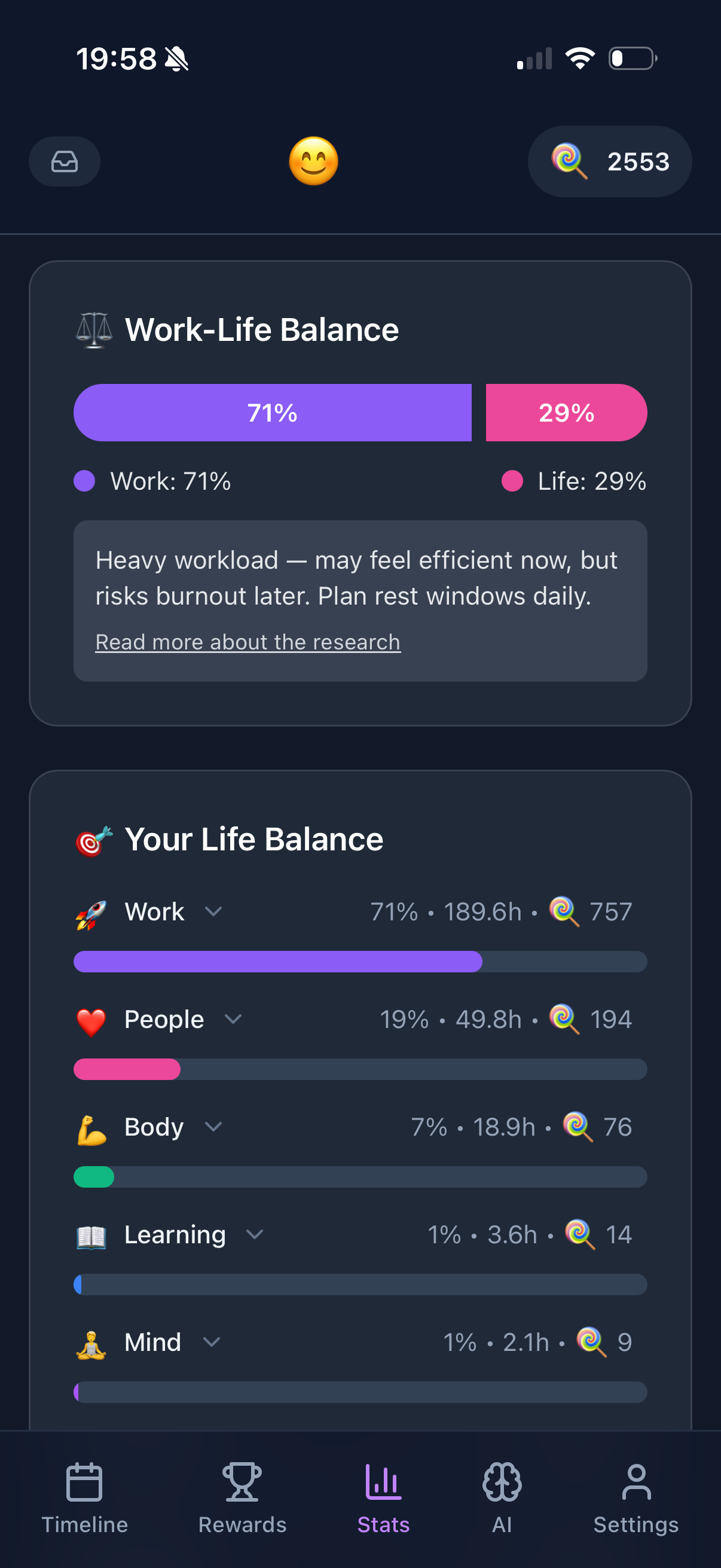
- Funtasking: Purpose Wheel shows 8 life areas. You see instantly when Work is crushing Health, Play, Relationships. Visual guilt-free accountability.
- Minimalist list apps: Clear, Apple Reminders, Microsoft To Do. No features. Just lists. Boring and effective.
- Paper systems: Bullet journal, plain notebook. Can't get distracted by app notifications when there's no app.
The common thread? These don't try to do everything. They pick one thing and do it well.
The Life Balance Problem Nobody Talks About
Here's a controversial take from r/getdisciplined that stuck with me:
"Productivity apps assume your problem is getting more done. But what if your problem is that you're doing too much of the wrong things? No app helps with that. They just help you be more efficient at being imbalanced."
Think about it. Most apps show you tasks. Work tasks, usually. They don't show you:
- When you last exercised
- How many hours you spent with family this week
- Whether you've done anything fun in 10 days
- If your life is actually balanced or just busy
You can have perfect task completion and still feel like garbage. Because you completed 50 work tasks and zero "call friend" or "go for walk" tasks.
What Changed for Me
I'll be honest. I was the person with 47 apps. Notion templates, Todoist projects, Asana boards, the works.
What changed wasn't finding a better app. It was asking a different question.
Instead of "how do I get more done?" I asked "what actually matters?"
Turns out, most of my to-do list was fake urgency. Things that felt important but weren't. When I started tracking life balance instead of task completion, everything shifted.
The Balance Test (Try This)
Look at your last week. Rate each area 1-10:
- Work/Career: ___
- Health/Fitness: ___
- Relationships: ___
- Fun/Play: ___
- Learning/Growth: ___
- Rest/Recovery: ___
If one area is a 9 and others are 2s, you don't have a productivity problem. You have a balance problem. No task app fixes that.
FAQ: Why Apps Keep Failing You
Q: Why do productivity apps never work for me?
Most apps fail because they add complexity instead of removing it. You spend more time organizing tasks than doing them. The app becomes another thing to maintain. Reddit users report success only when they find apps simple enough to use without thinking - usually the ones with the fewest features, not the most. The goal is a tool that disappears into your workflow, not one that becomes another obligation.
Q: Is there a productivity app that actually helps?
Yes, but the key is matching the app to your actual problem. If you're overwhelmed, you need fewer features not more. Reddit recommends apps like Funtasking that focus on life balance rather than cramming more tasks into your day. The apps that work are ones you forget you're using because they're that simple. Stop looking for the perfect app. Find the adequate one and commit.
Q: Why do I keep downloading new planning apps?
It's called productivity procrastination. Setting up a new app feels productive but it's actually avoidance. Reddit calls this the "app graveyard cycle" - download, customize for 3 hours, use for 2 weeks, abandon, repeat. The fix isn't finding the perfect app. It's committing to an imperfect one and actually using it. The best system is the one you'll stick with, not the one with the best features.
Q: What's wrong with most task management apps?
They optimize for the wrong thing. Most apps help you do MORE tasks, not the RIGHT tasks. They gamify productivity with hollow rewards that stop working after a week. They ignore that humans need rest, play, and relationships - not just completed checkboxes. Reddit increasingly recommends balance-focused apps over pure task managers. The question isn't "did I complete my tasks?" It's "am I living well?"
The Uncomfortable Truth
No app will fix your productivity. Sorry. I know that's not what you wanted to hear.
Apps are tools. A hammer doesn't build a house. You do. The hammer just helps.
If you keep jumping between apps, the problem isn't the apps. It's one of these:
- Unclear priorities: You don't know what actually matters, so everything feels urgent
- Avoidance: You're avoiding something specific. The app-switching is the avoidance.
- Wrong metric: You're measuring tasks completed instead of life quality
- No boundaries: You say yes to everything, then need "productivity" to fit it all in
Fix those, and any simple app works. Don't fix those, and no app will save you.
What Actually Works: Reddit's Consensus
After reading hundreds of threads, here's what consistently works for people who escape the app graveyard:
The Pattern of People Who Stay Productive
- One system, imperfect: They pick something and commit for 90 days minimum. No switching.
- Stupid simple: Usually paper or one basic app. Never more than 3 tools total.
- Balance awareness: They track life areas, not just tasks. Apps like Funtasking that show the whole picture.
- Weekly review: 15 minutes every Sunday to see what actually happened vs. planned.
- Self-compassion: They skip days without guilt spiraling. Miss Monday? Start Tuesday. No drama.
That's it. Nothing fancy. No $300 Notion template. No elaborate setup. Just consistency with simple tools.
The Bottom Line
Your productivity problem probably isn't a lack of the right app. It's one of these:
- Too much complexity (simplify ruthlessly)
- Wrong priorities (figure out what actually matters)
- No balance awareness (track life, not just work)
- Shiny object syndrome (commit to one tool for 90 days)
The app that works is the one you'll actually use. For most people, that's the simplest one available.
Stop searching for perfect. Start using adequate. Your 48th app isn't the answer. Actually doing the work is.