Last updated: January 2025. Based on discussions from r/selfcare, r/productivity, r/selfimprovement, r/DecidingToBeBetter.
"I crushed my todo list this year. 847 tasks completed. And I feel... nothing. I forgot to see friends. I haven't exercised in months. When did I last do something just for fun? I was so productive I forgot to have a life."
This confession appears constantly on Reddit. The productivity trap: optimizing tasks while neglecting the human being doing them. Here's what the research and community actually recommend.
The 8 Dimensions of Wellness
SAMHSA's Wellness Framework
The Substance Abuse and Mental Health Services Administration identifies 8 dimensions of wellness that interact and influence each other. Neglecting any dimension eventually affects the others. Research by Diener, Oishi, and Tay (2018) on subjective well-being confirms that life satisfaction requires balance across multiple domains - not excellence in just one.
Physical
Exercise, nutrition, sleep, medical care
Emotional
Processing feelings, stress management, self-acceptance
Intellectual
Learning, creativity, mental stimulation
Social
Relationships, community, belonging
Occupational
Work satisfaction, professional growth
Environmental
Living space, nature, physical surroundings
Spiritual
Purpose, values, meaning, connection to something larger
Financial
Money management, security, reducing financial stress
Why Productivity Apps Miss the Point
The Work-Only Trap
Most todo apps are designed for work tasks. Open Todoist, Things 3, or Notion - the default assumption is you're tracking projects and deadlines. Where do you put "call mom"? "Take a walk"? "Read for fun"? These feel out of place in a productivity system. So you don't add them. And slowly, they disappear from your life entirely.
The Upward Spiral Effect
Research on well-being shows that improvement in one life area creates positive spillover to others. Eakman (2016) found that life satisfaction is directly linked to how well basic psychological needs are met across different domains. This creates an upward spiral: better sleep improves work, better relationships reduce stress, exercise boosts mood, which improves everything.
The reverse is also true. Neglecting areas creates downward spirals: overworking leads to poor sleep, which leads to relationship strain, which leads to poor health decisions...
Apps That Track More Than Work
| App |
Life Areas |
Self-Care Focus |
Balance View |
Non-Work Tasks |
Price |
| Funtasking |
8 areas (Purpose Wheel) |
Play, Body, Mind categories |
Visual wheel shows balance |
Equal to work tasks |
Free / $2.99 Pro |
| Daylio |
Mood + activities |
Mood tracking focus |
Mood patterns only |
Activity tracking |
Free / $4.99/year |
| Fabulous |
Health routines |
Self-care focused |
Journey-based |
Wellness habits |
Free trial / $60/year |
| Finch |
Self-care categories |
Gentle, pet-based |
Pet growth = progress |
Focus on wellbeing |
Free / $40/year |
| Todoist |
Custom projects only |
Work-focused design |
No balance features |
Feels out of place |
Free / $4/mo |
| Things 3 |
Custom areas |
GTD-focused |
No balance view |
Work-optimized |
$49.99 one-time |
The Purpose Wheel Approach
Funtasking's 8 Life Areas
Body
Mind
Connection
Work
Learning
Impact
Play
Space
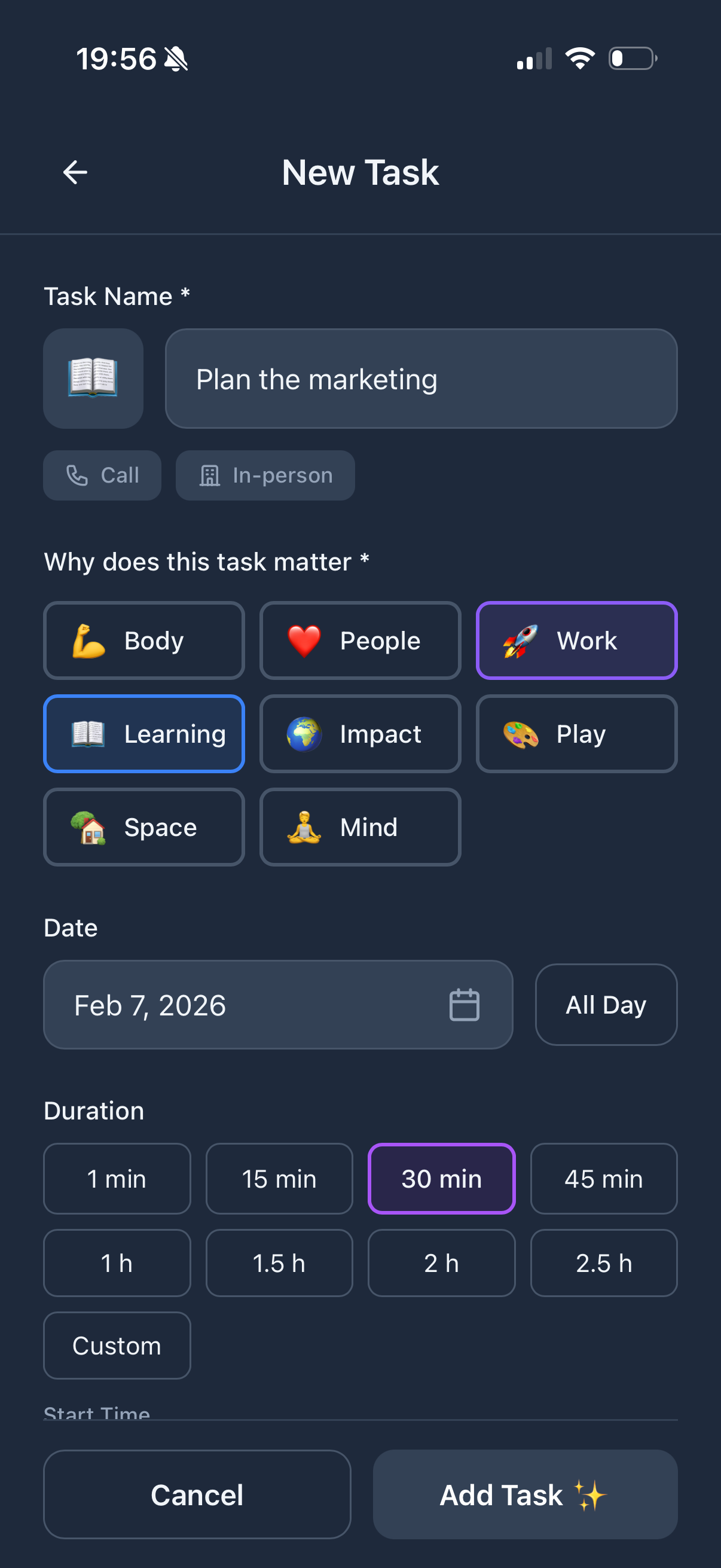
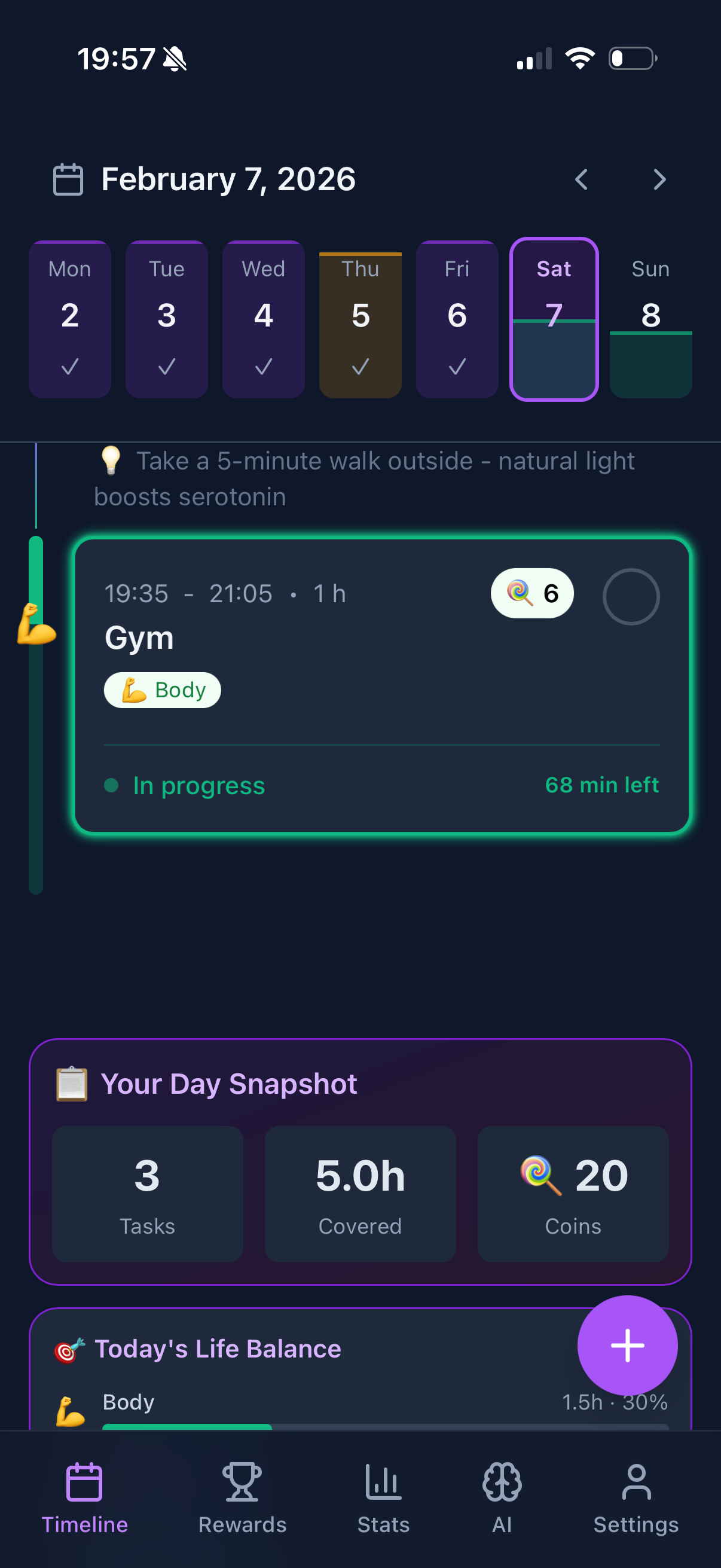
When you create a task, you assign it to an area. The visual wheel shows which areas you're focusing on - and which you're neglecting.
Why Fixed Categories Help
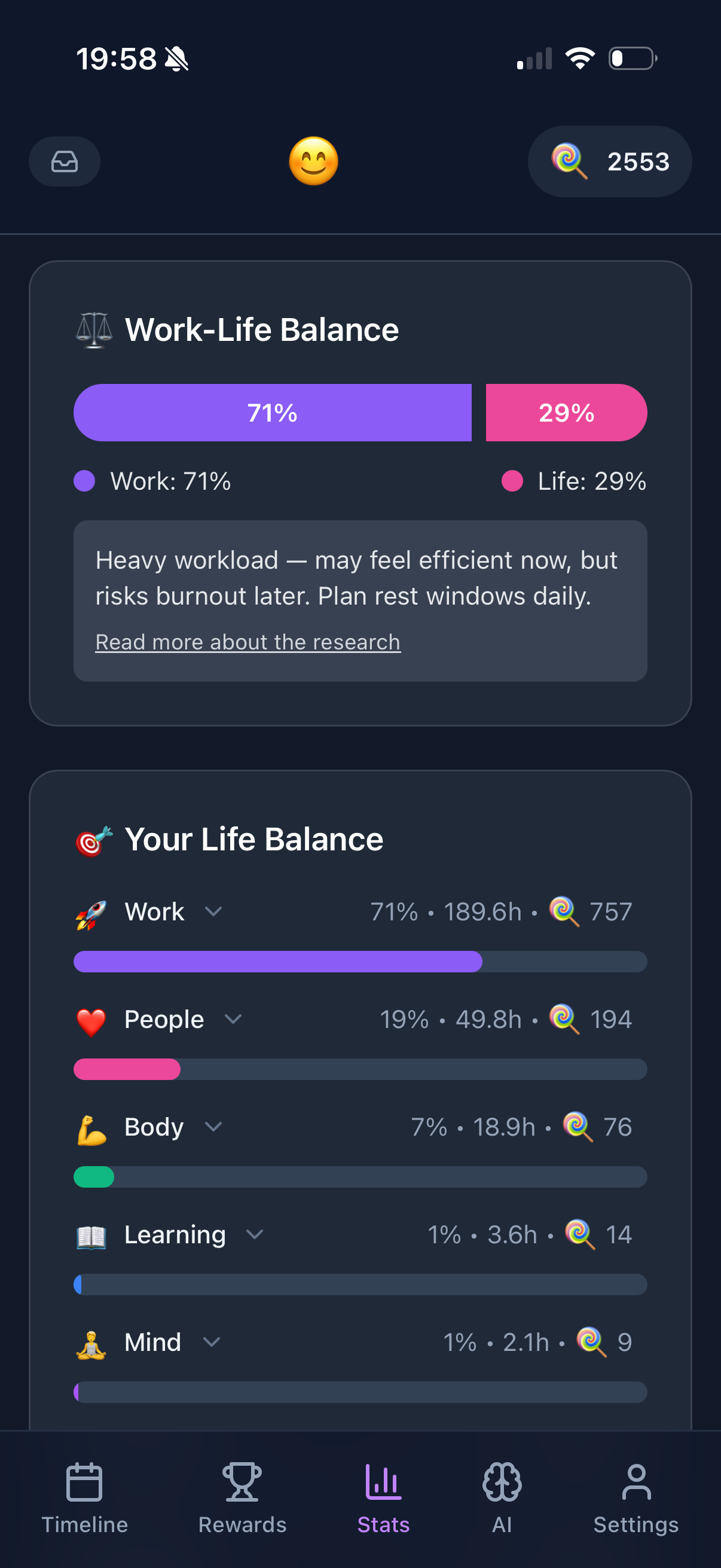
Research on the "Wheel of Life" coaching tool (Byrne, 2005) shows that having predefined life categories helps people recognize imbalances they'd otherwise miss. Instead of "I feel bad but don't know why," you see "I haven't done anything for Connection or Play in 3 weeks." The visualization makes abstract neglect concrete and actionable.
Self-Care Ideas by Category
Body
- Take a 10-minute walk (not a workout - just movement)
- Drink water before coffee
- Go to bed 15 minutes earlier
- Stretch for 5 minutes
- Make a doctor appointment you've been postponing
Mind
- Journal for 5 minutes (no structure needed)
- Meditate (apps: Headspace, Calm, Insight Timer)
- Therapy session or mental health check-in
- Say no to something that doesn't serve you
Connection
- Text a friend you haven't talked to
- Call family member (schedule it like a meeting)
- Have a meal with someone without phones
- Join a community group or class
Play
- Do a hobby with zero productivity goal
- Watch something purely for enjoyment
- Play a game (video, board, whatever)
- Do something silly that makes you laugh
Reddit Q&A
"Self-care feels selfish/unproductive"
This is productivity culture talking. Research consistently shows that rest and recovery improve performance. You're not a machine - even machines need maintenance. Viewing self-care as "productive" might help reframe it: you're maintaining the most important tool you have (yourself).
"I don't have time for self-care"
Start with 5-minute micro-actions. A 5-minute walk is self-care. Texting a friend is self-care. You don't need hour-long spa sessions. The key is consistency, not duration. Apps like Funtasking reward any task completion equally - a 15-minute walk earns the same coin as a 15-minute work task.
"How do I remember to do self-care?"
Put it in your system like any other task. Schedule "call mom" like a meeting. Add "10-min walk" to your morning routine. The problem is treating self-care as optional extras rather than essential maintenance. Visual planners that show life balance help - seeing "Play: 0 tasks this week" is motivating.
"Everything feels like a chore, even fun things"
This might be burnout or depression. When even pleasurable activities feel like obligations, it's a sign something deeper needs attention. Consider: reducing overall commitments, talking to a therapist, or taking genuine time off (not "productive rest"). Apps won't fix this - but recognizing the pattern is the first step.
The Anti-Productivity Approach
Why Funtasking Rewards "Unproductive" Tasks
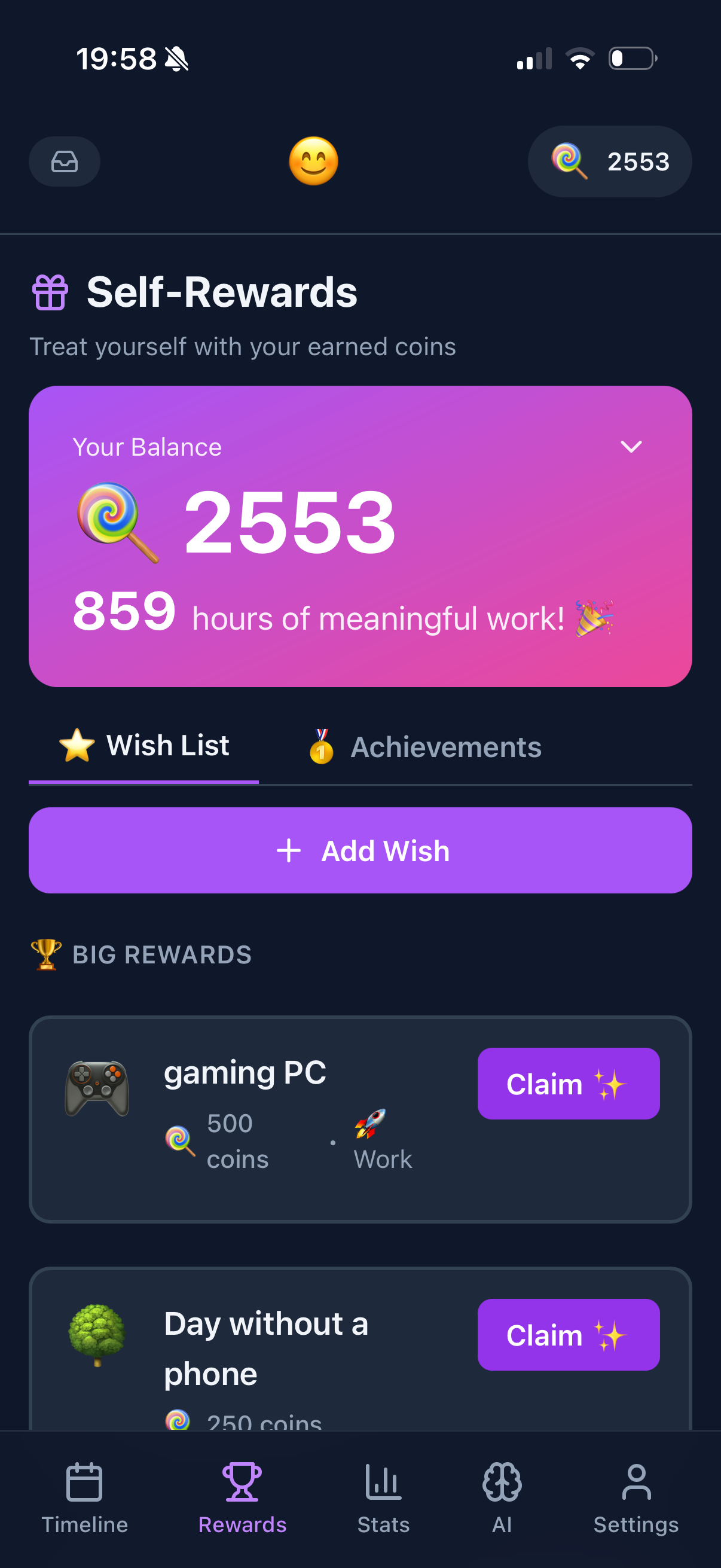
In Funtasking, you earn coins for completing ANY task - Work, Play, Body, or Mind. A 15-minute nap earns the same as a 15-minute work session. This deliberately counteracts the cultural message that only work "counts." Research on gamification shows that rewarding behaviors increases their frequency. By rewarding self-care equally, the app helps rebuild habits that productivity culture eroded.
Signs You Need More Self-Care
- You can't remember your last truly fun activity
- Rest feels "lazy" or makes you anxious
- You've been "too busy" for friends/family for months
- Small tasks feel overwhelming
- You're always tired despite sleeping
- Accomplishments feel empty
- You've stopped hobbies you used to enjoy