Most daily planners have a fundamental problem: they only plan work.
Open any traditional planner app and you'll see: projects, tasks, deadlines, meetings. All work. Maybe you can add personal projects, but the structure is still work-centric. What about your health? Your relationships? Having fun?
A daily planner with life areas is different. It recognizes that your day has more dimensions than just work. It gives you a framework to plan across everything that matters - and to notice when important areas are being neglected.
The key insight: A productive day where you ignored your health, relationships, and personal needs is not actually a good day. Life area planning helps you define success more holistically.
The 8 Life Areas Explained
Funtasking's Purpose Wheel is built around 8 essential life areas. Here's what each one means and how to plan for it:
💼 Career & Work
Your professional life: job tasks, career development, work projects, business goals. This is what most planners focus on exclusively.
Example tasks: Complete quarterly report, update resume, network with industry contact, learn new skill for work, apply for promotion
Why it matters: Career provides income, purpose, and identity for many people. It deserves attention - but not all your attention.
💪 Health & Fitness
Physical and mental health: exercise, nutrition, sleep, medical care, stress management. The foundation that makes everything else possible.
Example tasks: 30-minute walk, meal prep, annual checkup, 8 hours of sleep, 10-minute meditation, drink more water
Why it matters: Without health, nothing else works. Yet health tasks are often the first to be dropped when work gets busy.
❤️ Relationships
Human connections: family, friends, romantic partner, community. The relationships that give life meaning beyond achievement.
Example tasks: Call mom, date night, coffee with friend, family dinner, text to check in, send thank-you note
Why it matters: Research consistently shows relationships are the strongest predictor of life satisfaction. They need intentional attention.
🌱 Personal Growth
Self-improvement: learning, reading, courses, therapy, mindfulness, skill development outside of work. Becoming who you want to be.
Example tasks: Read 20 pages, online course lesson, journal entry, therapy session, learn new recipe, practice instrument
Why it matters: Growth keeps life interesting and builds long-term capability. It's easy to neglect when focused on immediate demands.
🎮 Fun & Recreation
Enjoyment: hobbies, entertainment, play, creativity, relaxation. The things you do because they're fun, not because they're productive.
Example tasks: Play video games, watch movie, work on hobby project, go to concert, creative writing, play with kids
Why it matters: Fun recharges you and prevents burnout. Hustle culture has convinced many people that fun is wasteful. It's not.
💰 Finance
Money management: budgeting, saving, investing, financial planning, debt management. Building financial security and freedom.
Example tasks: Review budget, pay bills, check investments, research purchases, update financial plan, negotiate rate
Why it matters: Financial stress affects everything. Regular attention to finances prevents crises and builds freedom.
🏠 Environment
Physical space: home organization, cleaning, decorating, creating spaces that support your life. Where you live affects how you live.
Example tasks: Declutter closet, clean kitchen, organize desk, fix broken item, buy needed furniture, improve lighting
Why it matters: Cluttered, dysfunctional spaces drain energy. Clean, organized spaces support wellbeing.
🤝 Contribution
Giving back: volunteering, charity, helping others, community involvement. Contributing to something beyond yourself.
Example tasks: Volunteer shift, donation, mentor meeting, community event, help neighbor, teach skill to others
Why it matters: Contributing to others provides meaning and perspective. It's a consistent factor in life satisfaction research.
How Competitors Handle Life Areas
Todoist, Things, TickTick
Traditional task managers let you create projects and tags, so you could theoretically organize by life area. But the structure doesn't encourage it. Most users end up with work-heavy lists because that's what the apps implicitly prioritize.
Life area support: Minimal. DIY possible but not encouraged.
Notion
Notion is infinitely flexible, so you can build any system you want. But most templates focus on productivity and projects. Creating a life-area system requires significant setup and discipline to maintain.
Life area support: Possible but requires custom setup.
Finch
Finch focuses on self-care, which overlaps with Health and sometimes Growth. But it's not a complete planner - it's more of a wellness companion. Career, Finance, and other areas aren't really covered.
Life area support: Partial. Good for self-care, not complete.
Funtasking
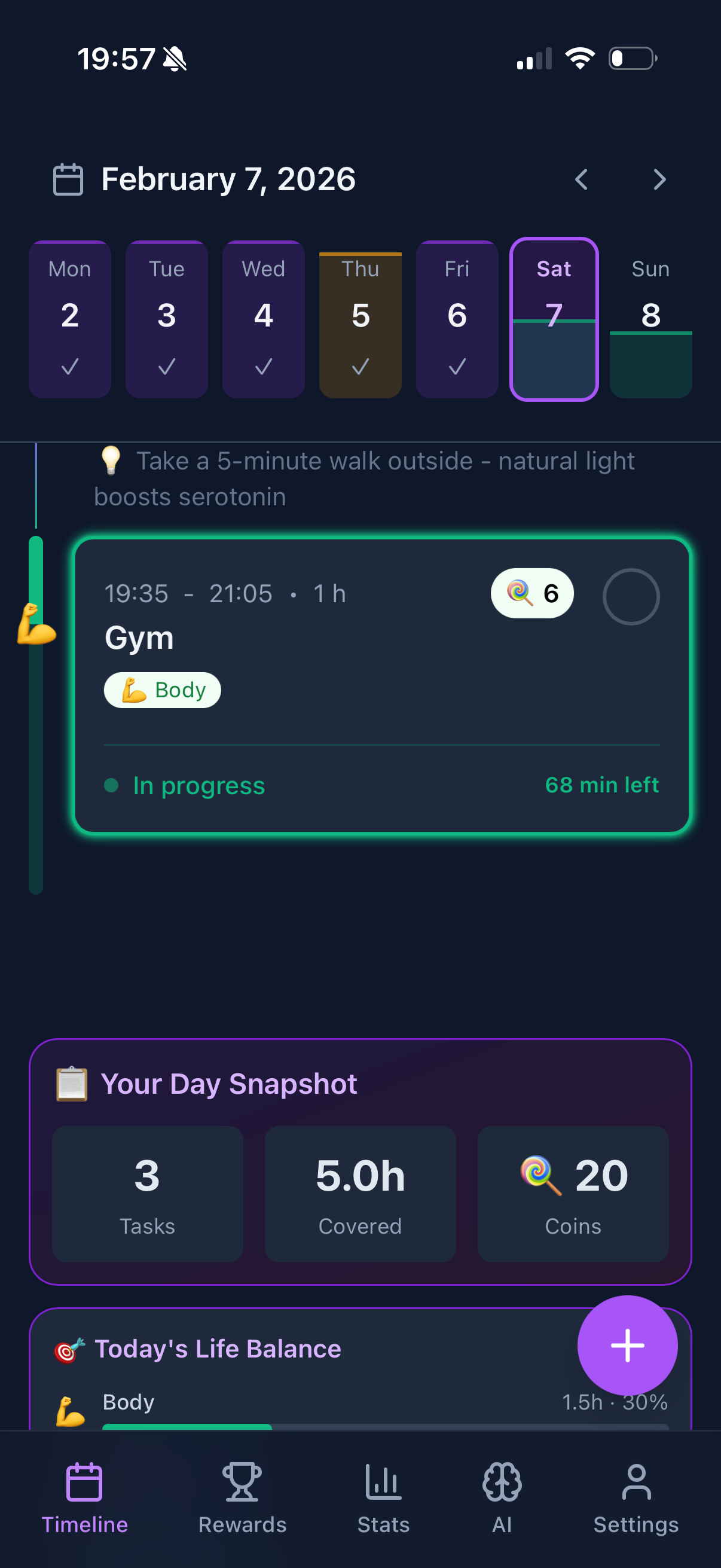
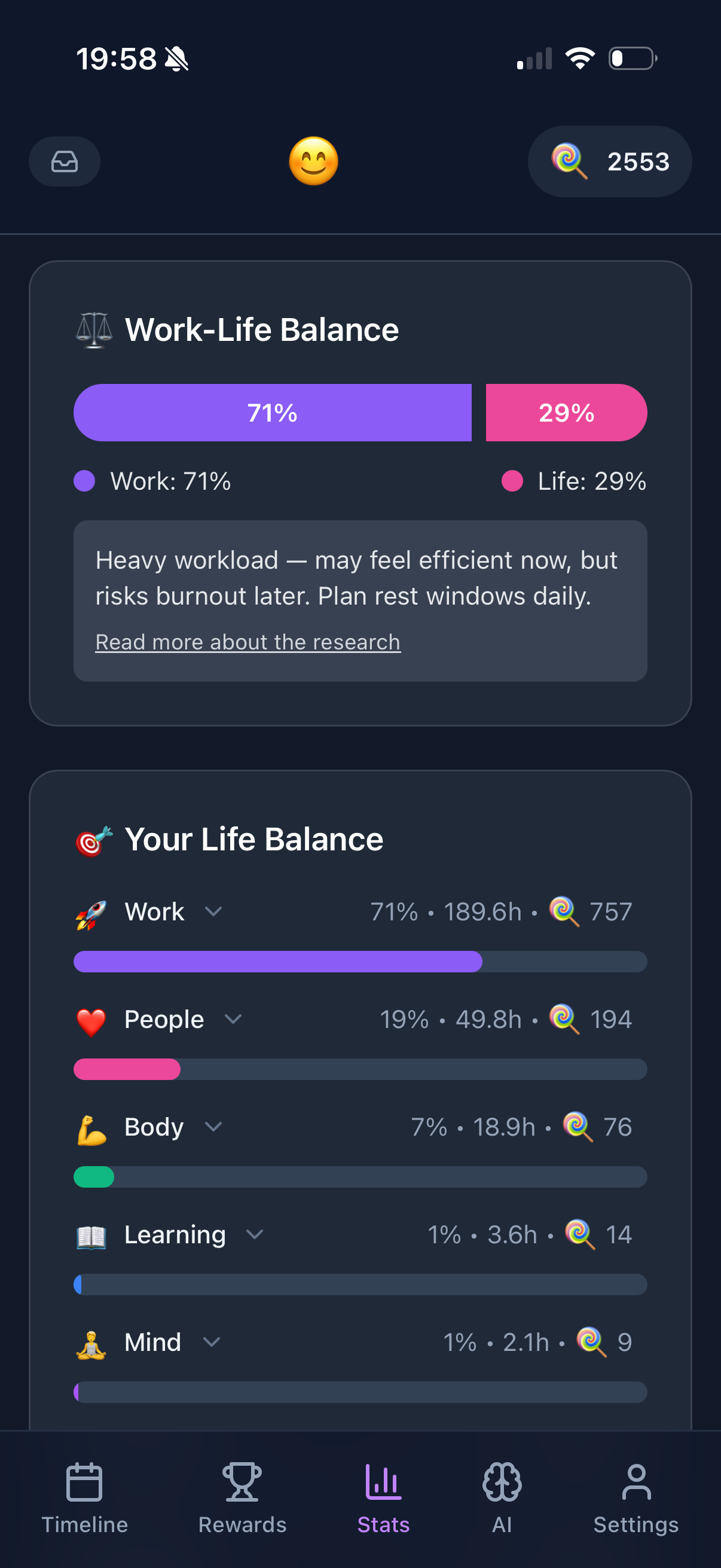
Funtasking is built around the 8 life areas. Every task belongs to a category, and the Purpose Wheel shows your balance at a glance. It's the core design philosophy, not an afterthought.
Life area support: Native and central to the app.
Daily Planning with Life Areas
The Morning Check-In
When you start your day, glance at your Purpose Wheel. Which areas are full? Which are empty? This takes 10 seconds and gives you important context for planning.
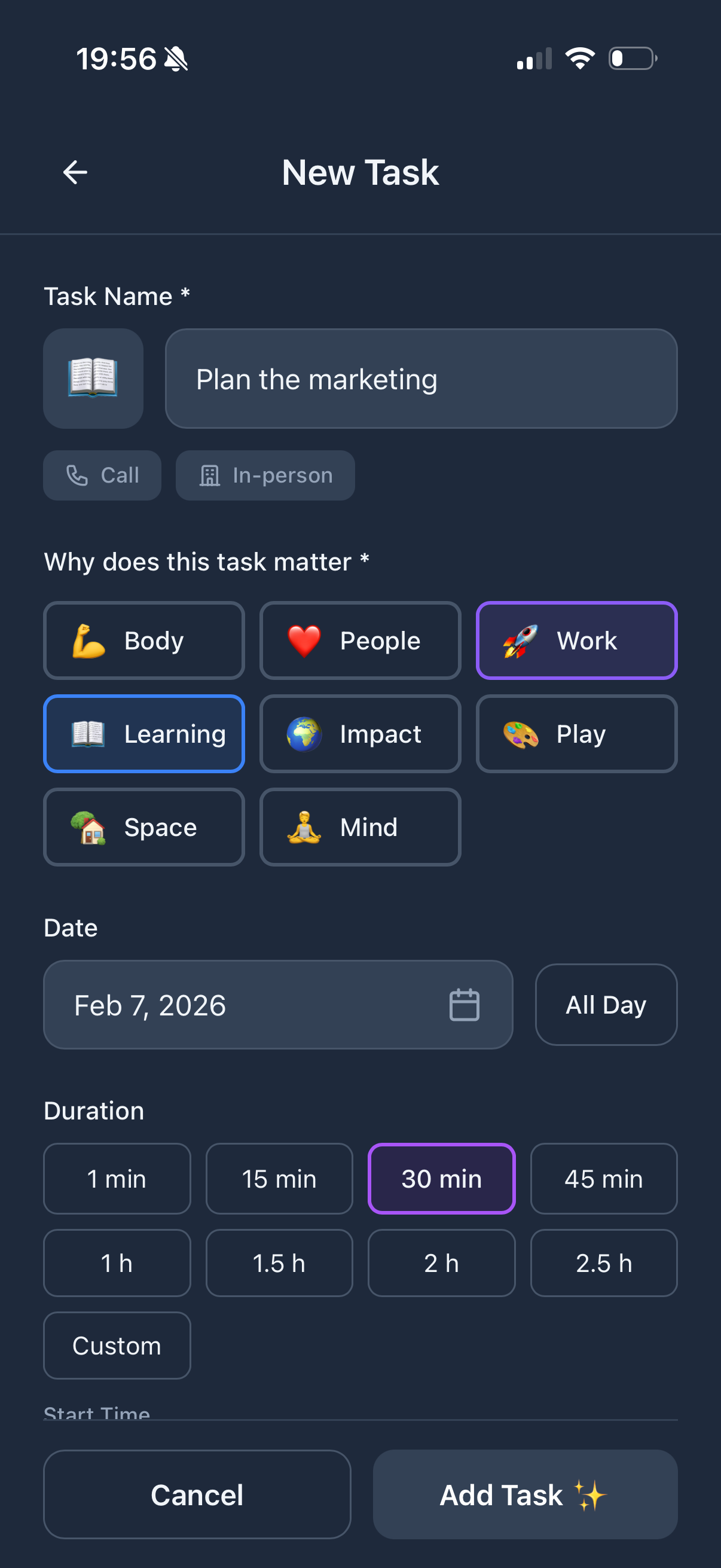
Adding Tasks with Categories
As you add tasks, assign them to life areas. This takes one extra second per task but transforms your planning. Instead of a flat list of work, you see the shape of your day across all dimensions.
Intentional Balance
You don't need to hit every area every day. But if you notice Health has been empty for a week, maybe today you add one small health task. The life area framework supports conscious choices about balance.
Don't overdo it: Eight areas doesn't mean eight kinds of tasks every day. That's a recipe for overwhelm. The framework is for awareness, not perfection. Some days are Career-heavy, and that's fine - as long as you're choosing it consciously.
Sample Daily Plans
A Balanced Weekday
- Career: Complete project milestone, attend team meeting
- Health: Morning run, healthy lunch
- Relationships: Call friend during lunch break
- Fun: Evening reading time
A Weekend Day
- Relationships: Family brunch
- Fun: Hobby project
- Environment: Clean apartment
- Growth: Online course lesson
A Recovery Day
- Health: Extra sleep, gentle walk, good meals
- Fun: Whatever feels restorative
The point: Life areas give you a vocabulary for planning that goes beyond just "tasks." They help you see your day as part of a whole life, not just a work schedule.
Getting Started
1. Start Simple
You don't need to master all 8 areas immediately. Start by just categorizing the tasks you're already doing. Notice what categories they fall into. Notice what's missing.
2. Add One Neglected Area
Pick one area that's been empty and add a small task. If Health has been neglected, add a 10-minute walk. If Relationships has been empty, schedule one call. Small steps build momentum.
3. Review Weekly
Check your Purpose Wheel each week. Which areas grew? Which stayed flat? Use this to guide next week's focus. The visual makes patterns obvious.
4. Don't Aim for Perfect Balance
Balance doesn't mean equal time everywhere. It means no area is completely neglected while you hyper-focus on others. Some weeks will be Career-heavy. That's fine - as long as you're aware and it's temporary.
Plan Your Whole Life
Funtasking helps you balance all 8 life areas with the Purpose Wheel. See your whole life at a glance.
Try Life Area Planning
Related Articles